
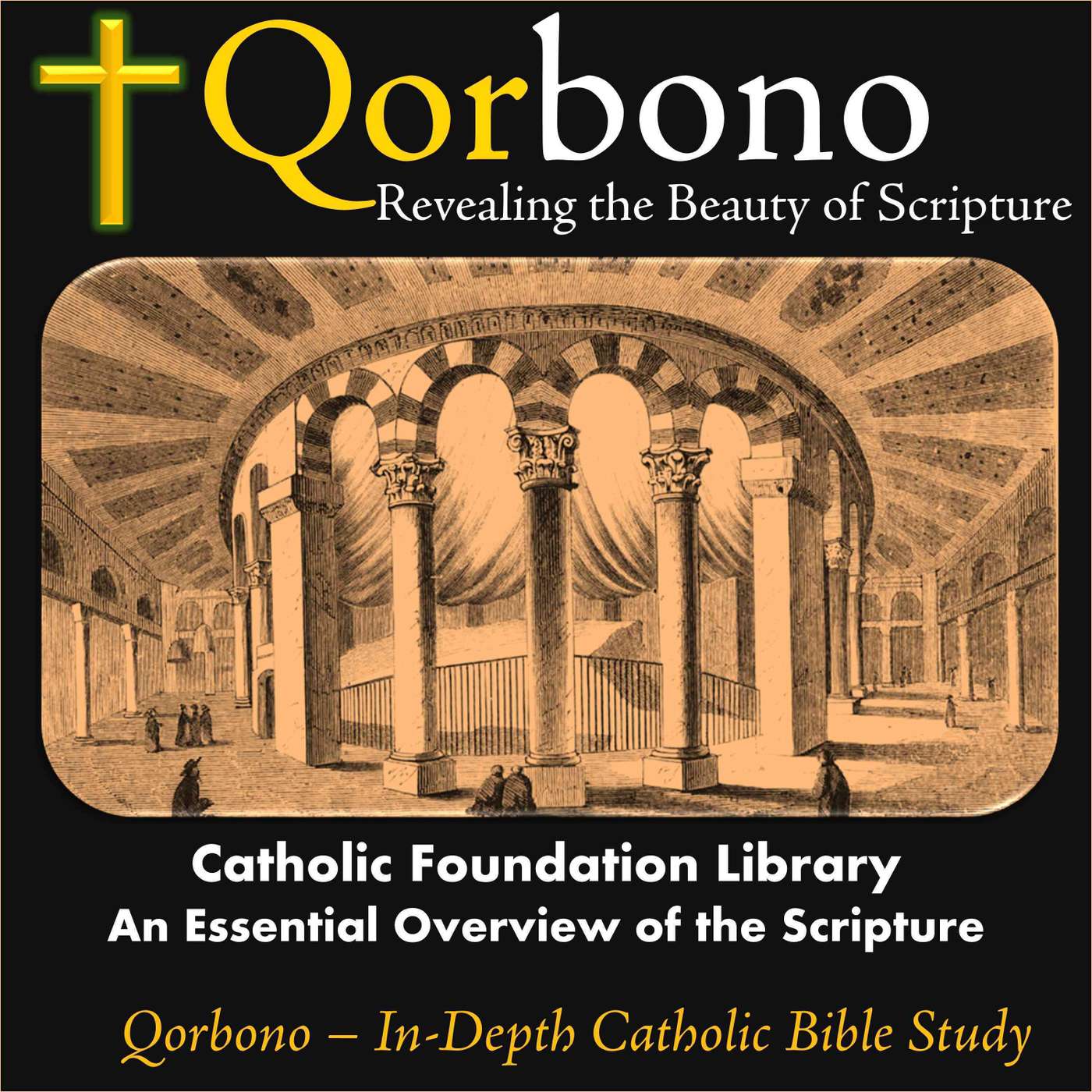
CFL 13: The Temple's Architecture
Catholic Foundation Library
Catholic Foundation Library #13 The Temple of Jerusalem, built during the reign of Solomon, was the only place on Earth God dwelt in a visible fashion. The Shekinah, the Presence of the Lord, was in the Holy of Holies until shortly before the destruction of Jerusalem by Babylon in 587 A.D. The Temple was built with a system of concentric courts. The Court of the Gentiles was open to everyone. It was the largest court and anyone, Jew or Gentile, could walk there. A dividing wall separated this court from that of the women where only the men and women of Israel could enter; a law enforced under penalty of death. The beautiful gate separated the court of the women from the court of men and women were not allowed to go past that gate. A small wall separated the court of men from the court of the priests. Inside this court stood the great altar of sacrifice and the bronze laver in which twelve priests could bathe themselves. It was inside this court that the Temple proper stood. Known otherwise as the Holy, this building was inlaid with gold inside and out. Inside and towards the back stood an impressive curtain that was twenty feet wide and thirteen feet high. Behind the curtain was the Holy of Holies, a cube where the tabernacle was placed and where the Shekinah, the presence of the Lord dwelt. Highlights Why all these courts? Why not have one external court and then the Temple proper? Why was the altar of sacrifice outside the Temple proper? What did the Holy contain and why?
About Podcast
Qorbono offers in-depth bible studies meant to help you make sense of the Scriptures according to the mind of the Catholic Church.
The Catholic Foundation Library is an essential study of Scripture to help you understand God's overarching plan. It covers essential elements required to better understand the Gospels and the words of Jesus: How should we read the Scripture? What is a covenant and why is it important? How should we understand numbers like 666? The Bible is filled with symbolic figures such as horses, lions, and trumpets. What do they mean? These are a few of the important topics this Library covers.
Do you have a good handle on Scripture? Can you explain in a few words what the purpose of Scripture is according to the Catholic Church? Is your life biblical? Are you at peace, knowing that God is truly in control? Learn how the books of Scripture form a beautiful mosaic that is at once ancient and new.